

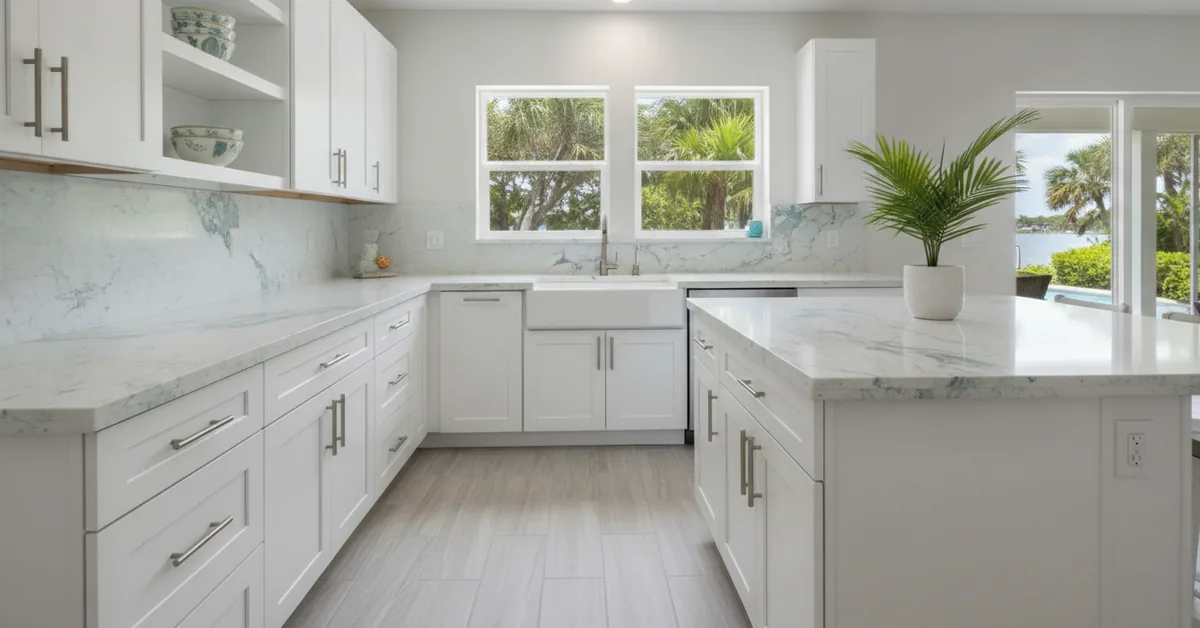
I get the call at least once a month. It’s usually from a homeowner in a beautiful property on Lido Key or Siesta Key who spent a fortune on a “dream kitchen” just a few years ago. Now, the cabinet doors won’t close properly, the paint is cracking at the joints, and there’s a subtle, persistent stickiness to every surface. They show me their stunning solid wood cabinets, and I have to be the one to explain that the very material they prized as a mark of quality is the primary cause of their kitchen’s premature failure. In Sarasota, our beautiful coastal environment is relentless, and it demands a completely different approach to cabinet design—one that often goes against conventional wisdom.
The Sarasota Kitchen Blueprint: Four Pillars of Coastal Durability
- Material Stability Over Perceived Value: Prioritize engineered materials like high-grade, moisture-resistant MDF or dimensionally stable wood species over traditional solid woods that warp and swell in our high humidity.
- Hardware is Not an Accessory, It's a Defense: Select marine-grade stainless steel (316 grade) or hardware with specialized PVD coatings to combat the corrosive effects of salt air, which will destroy standard steel in months.
- Finish Technology is Your First Line of Defense: A high-quality, post-catalyzed conversion varnish or a similar two-part polyurethane finish is non-negotiable. It creates an impermeable barrier against moisture that standard lacquer or paint cannot match.
- Design for Airflow, Not Just Aesthetics: A successful coastal kitchen design incorporates subtle ventilation strategies, like integrated valances or toe-kick vents, to prevent stagnant, humid air from being trapped inside cabinetry.
Why Your 'Solid Wood' Dream Kitchen Becomes a Humid Nightmare
Let me tell you about a project I consulted on in a Casey Key home. The kitchen was less than four years old, featuring gorgeous, custom-painted solid maple shaker doors. The problem? Nearly every single door panel had expanded so much against its frame that it had cracked the paint at the joints, creating ugly, dark lines. Some doors were so swollen they wouldn't even close flush. The homeowner believed they had bought the best, but in reality, they bought the wrong material for our environment. Wood is a natural material; it breathes. In Sarasota's relentless humidity, it inhales moisture and expands. In the drier winter months, it exhales and contracts. This constant movement, known as hygroscopic swelling, is the enemy of a perfect cabinet finish and a stable door. The most expensive material is not always the best material for the application.
The Unspoken Truth: Engineered Cores vs. Solid Wood in Coastal Climates
In my workshop, I've seen the science play out time and again. For painted cabinetry in a home west of I-75, I almost exclusively recommend doors constructed from a high-grade, moisture-resistant Medium-Density Fiberboard (MDF). Clients sometimes hesitate, associating MDF with cheap furniture. But professional-grade MDF is a completely different product. It's an engineered wood product that is dimensionally stable—it does not expand or contract with humidity changes. This stability means that a painted finish applied to it will not crack or fail at the joints, because there are no joints. For a flawless, lasting painted finish, it is simply the superior choice here.
| Material | Primary Strength | Primary Weakness in High Humidity | Best Use Case in Sarasota |
|---|---|---|---|
| Solid Maple (Painted) | Perceived high value | High expansion/contraction; leads to paint cracks at joints | Not recommended for painted finishes; maybe for small, stained accent pieces |
| Moisture-Resistant MDF | Dimensionally stable; perfect paint surface | Lower screw-holding strength (requires proper construction) | The gold standard for any painted cabinet door or panel |
| Quarter-Sawn White Oak | Extremely stable for a solid wood | High cost; distinct grain not suitable for all styles | High-end, stained wood kitchens where grain is a feature |
| Marine-Grade Plywood | Excellent structural strength and water resistance | Rougher surface, not ideal for fine finishes without significant prep | Cabinet boxes (carcasses), especially for sink bases and outdoor kitchens |
Hardware & Finishes: The Unsung Heroes of a Coastal Kitchen
The battle isn't just with the wood. Salt air is a relentless corrosive agent. I've seen expensive drawer slides turn into rusty, grinding mechanisms in under two years because the builder used standard zinc-plated hardware. For any home near the water, investing in 316-grade stainless steel hardware is not a luxury, it's a necessity. This applies to everything: hinges, drawer slides, and even screws. The upfront cost might be 20-30% more for the hardware package, but it prevents a complete, labor-intensive replacement down the line. Similarly, the finish on your cabinets is a protective shield. We use a two-part conversion varnish that chemically cures into a hard, non-porous shell. This is a world away from a standard lacquer that can allow moisture to slowly penetrate, causing the underlying material to fail.
Your Action Plan for a Sarasota-Proof Kitchen
If you're planning a kitchen remodel in our unique climate, you need to be an educated consumer and ask your designer or cabinet maker the right questions. Here is what I advise my clients to do:
- Question the Materials: Directly ask, "What material are you proposing for the painted doors, and why is it the best choice for Sarasota's humidity?" If the answer is "solid wood" without a very specific, technical justification (like using a highly stable species like quarter-sawn oak), be cautious.
- Demand a Hardware Specification: Don't just accept "high-quality hardware." Ask for the specific material grade. Request "316 stainless steel" or a comparable marine-grade option for all functional hardware and get it in writing.
- Request a Finish Sample: Ask for a sample door or block with the exact finish that will be used. Try to scratch it with your fingernail. A high-quality conversion varnish will be extremely difficult to mark, whereas a softer lacquer will dent easily.
- Discuss Ventilation: Ask your designer, "How will the cabinet design promote air circulation to prevent trapped moisture, especially around the refrigerator and sink base?" This shows you understand the unique challenges of our environment.
Frequently Asked Questions from My Sarasota Clients
- Is there any solid wood that works well in Sarasota for cabinetry?
- Yes, but the choices are specific and often more expensive. Quarter-sawn white oak is exceptionally stable due to the way the log is cut, which minimizes expansion and contraction. Genuine mahogany and teak also have natural oils and a dense grain structure that make them resistant to moisture. However, for a painted finish, the stability of a premium engineered core is almost always the more reliable and cost-effective long-term solution.
- My condo is on the 10th floor on Longboat Key. Does the salt air really affect my kitchen that high up?
- Absolutely. Salt is carried in the air as a fine aerosol mist, and it's pervasive. While direct salt spray is less of an issue, the corrosive airborne particles will still get inside your home every time you open a window or lanai door. I've seen hardware on high floors fail just as quickly as on the ground floor. The elevation does not provide immunity, so specifying marine-grade hardware is just as critical.
- How much more should I budget for a 'coastal-grade' kitchen versus a standard custom kitchen?
- The primary cost increase is in materials and finishes, not labor. Expect to pay roughly 15-25% more for a project properly engineered for our coastal environment. This premium covers the upgrade from standard materials to moisture-resistant MDF or premium plywood, the significant jump to 316-grade stainless hardware, and the application of a high-performance conversion varnish finish. While it adds to the initial ticket, a standard kitchen might require major repairs or replacement in 5-7 years, making the coastal-grade investment far cheaper in the long run.