

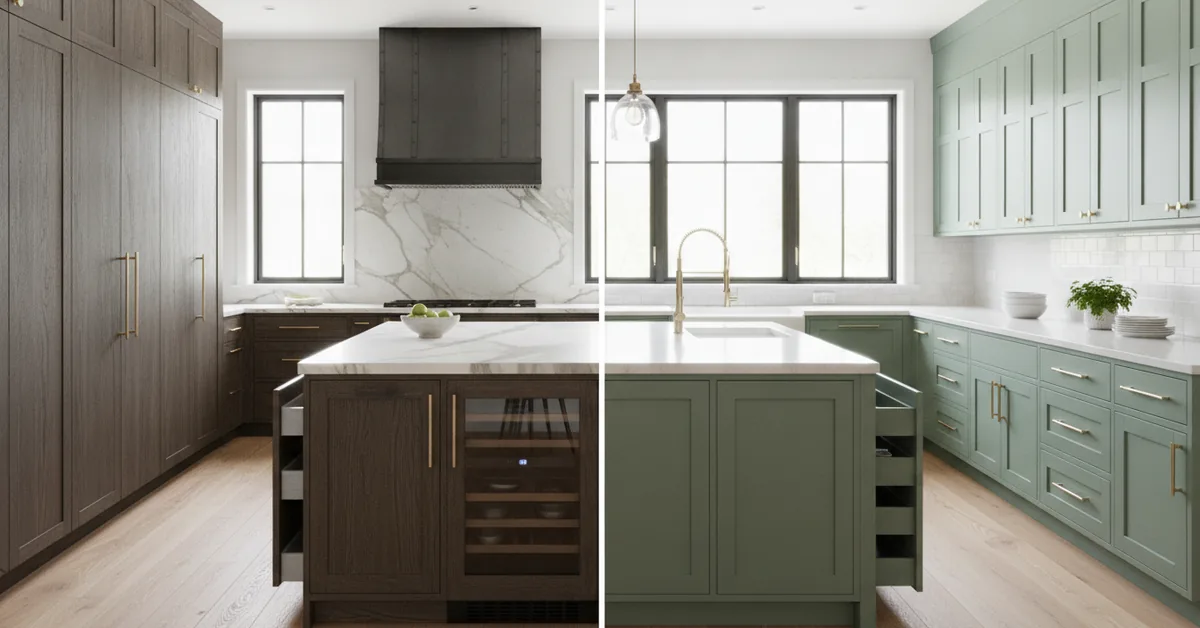
Last Tuesday, I stood in a client's half-demolished kitchen in Seattle, watching them run their fingers over a warped cabinet door they had purchased elsewhere just four years ago. It was a classic semi-custom box made of low-density particleboard, finished with a thin conversion varnish that had cracked around the joints due to seasonal humidity shifts. The client was shocked; they had paid premium prices, assuming the term 'semi-custom' guaranteed heirloom quality. The truth is, the cabinetry industry has blurred the lines between custom and semi-custom so aggressively that homeowners often pay custom prices for what are essentially dressed-up stock boxes. Understanding the physical differences in materials, finish chemistries, and hardware integration is what prevents a costly remodeling mistake.
The Core Elements of the Cabinetry Decision
Material Density Matters: Semi-custom lines typically rely on 1/2-inch engineered wood sides, whereas true custom
- Material Density Matters: Semi-custom lines typically rely on 1/2-inch engineered wood sides, whereas true custom cabinetry utilizes 3/4-inch domestic plywood or premium MDF for superior screw-holding capacity.
- Finish Chemistry Dictates Longevity: High-end custom shops use post-catalyzed conversion varnishes or Italian polyurethane applied in dust-free booths, while mass-production semi-custom lines often use thinner, UV-cured acrylics that are prone to chipping.
- Hardware Integration Limits: Semi-custom cabinets force you into standardized drawer slides and hinge placements, while custom builds allow for mortised, heavy-duty hardware integrated directly into the structural joinery.
- Structural Joinery Integrity: Custom cabinets rely on blind mortise-and-tenon or doweled joints, whereas semi-custom boxes are frequently held together with pocket screws, metal brackets, or hot-melt glue.
The Structural Anatomy: Plywood, MDF, and Joinery Secrets
When you strip away the beautiful paint and hardware, a cabinet is simply a five-sided box. In my workshop, I see how these boxes behave under the stress of heavy granite countertops and daily use. Semi-custom manufacturers keep costs down by using 1/2-inch thick industrial particleboard or medium-density fiberboard (MDF) for the cabinet sides (carcass). While modern MDF is incredibly flat and excellent for painted doors, using low-density versions for structural cabinet sides is a recipe for sagging over time.
True custom cabinetry relies on 3/4-inch cabinet-grade plywood—ideally 7-ply or 9-ply maple. This thickness ensures that the cabinet back can be fully rabbeted and screwed directly into the wall studs. In contrast, many semi-custom lines use a thin 1/4-inch back panel with a simple hanging strip. Over years of holding heavy ceramic plates, those hanging strips can pull away from the cabinet back, causing the entire box to shift and sag.
Comparing Materials, Finishes, and Hardware Specifications
To help you visualize where your money actually goes, I have broken down the technical specifications of what you are buying when you choose between these two construction methods.
| Specification Feature | Semi-Custom Cabinetry | True Custom Cabinetry |
|---|---|---|
| Box Construction Materials | 1/2-inch furniture board or import plywood | 3/4-inch domestic veneer-core plywood |
| Joinery Method | Pocket screws, staples, and plastic corner gussets | Doweled, glued, or blind mortise-and-tenon joints |
| Finish Type & Application | Flat-line UV-cured acrylic or thin conversion varnish | Multi-step hand-wiped stains, post-cat polyurethane |
| Hardware Integration | Standard face-mount hinges, limited slide options | Integrated undermount Blumotion, custom mortises |
| Dimensional Flexibility | 3-inch increments (fillers required for odd spaces) | 1/16-inch increments (zero fillers needed) |
The Chemistry of Finishes: Why Semi-Custom Cabinets Chip Early
In my fifteen years of refinishing and building, I have learned that a cabinet finish is only as good as its curing process. Most semi-custom cabinet doors are finished on a flat-line conveyor belt. They are sprayed with a UV-curable coating and cured in seconds under intense light. While this process is highly efficient and eco-friendly, it creates a very hard, brittle surface. Because wood naturally expands and contracts with changes in indoor humidity, this brittle finish often cracks at the joint lines of five-piece shaker doors, allowing moisture to seep in and blow out the wood fibers.
In a custom shop, we use post-catalyzed conversion varnishes or two-part polyurethane coatings. These finishes are mixed with a chemical hardener just before spraying, creating a flexible, elastic bond that moves with the wood. We also finish each door component individually before assembly in some cases, or we apply a hand-wiped micro-layer that ensures the joint lines remain sealed against steam from dishwashers and boiling pots.
Hardware Integration: Beyond the Soft-Close Hype
Almost every cabinet line today boasts soft-close hinges, but do not let that marketing term fool you. The difference lies in how that hardware is mounted to the cabinet box. Semi-custom cabinets often use generic European-style hinges screwed directly into the soft core of particleboard cabinet sides. Over time, the constant leverage of opening and closing heavy pantry doors enlarges these screw holes, leading to sagging doors that are impossible to align.
When I design custom cabinetry, I specify heavy-duty Blum or Grass hinges mounted into solid wood face frames or thick plywood system holes. Furthermore, custom design allows us to integrate specialized hardware like pocket doors, heavy-duty pull-out pantries rated for 200 pounds, and custom appliance panels that align perfectly with your architectural moldings. Semi-custom catalogs limit you to standard pull-out trash cans and basic lazy Susans that waste valuable corner space.
How to Assess Your Space: A Step-by-Step Selection Guide
If you are struggling to decide which route to take for your upcoming remodel, follow this practical checklist to determine which cabinet class matches your kitchen's physical footprint and your long-term goals.
- Measure your wall dimensions: If your kitchen has odd dimensions (e.g., a wall measuring 115 inches), semi-custom cabinets (which come in 3-inch increments) will require 5 inches of dead filler strips. If you hate wasted space, go custom to get cabinets built to the exact sixteenth of an inch.
- Evaluate your appliance package: Sub-Zero, Wolf, or Miele appliances often require precise, flush-inset panels. Semi-custom lines rarely offer the tight tolerances (usually 3/32 of an inch) required for a seamless integrated appliance look.
- Check your local climate: If you live in a coastal area or a region with high seasonal humidity, avoid semi-custom furniture board. Opt for custom marine-grade plywood or high-density, moisture-resistant MDF (MR50) to prevent warping.
- Define your timeline: Semi-custom cabinets typically ship in 4 to 8 weeks because the boxes are already pre-cut. Custom cabinetry is built from scratch and will require 12 to 24 weeks depending on the shop's backlog.
Frequently Asked Questions About Cabinetry Construction
- Can I mix semi-custom and custom cabinets in the same kitchen remodel?
- Yes, and it is a smart way to budget. I often recommend using semi-custom boxes for straightforward perimeter runs where standard sizes fit perfectly, and reserving your custom budget for a highly detailed island, a complex range hood mantle, or specialized pantry towers.
- Why do custom cabinets cost so much more if the raw wood materials are similar?
- The cost of custom cabinetry is not driven by the lumber, but by labor, engineering, and finish chemistry. Custom shops spend dozens of hours hand-sanding, grain-matching wood veneers so the grain flows continuously across drawer fronts, and engineering structural joints that can support heavy stone countertops without sagging.
- How can I tell if a semi-custom cabinet line is high-quality during a showroom visit?
- Look at the drawer boxes. Pull a drawer all the way out and inspect the joinery. If you see staples or pinned joints instead of tight, maple dovetails, walk away. Press down on the bottom of the drawer box; if it flexes or is made of thin 1/4-inch plywood, it will not hold up to heavy pots and pans.