

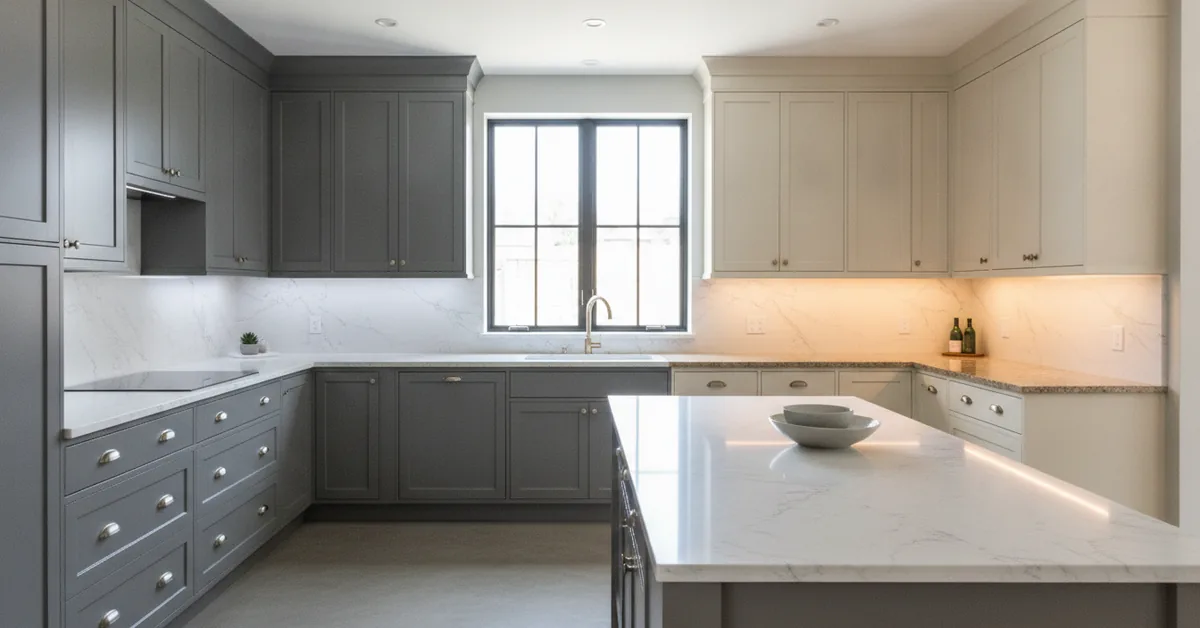
I’ll never forget the call. A client, whose kitchen we had just completed, was distraught. The custom-mixed, Farrow & Ball “Elephant's Breath” gray cabinets we had painstakingly finished in the shop looked, in her words, “a sickly, muddy purple” under her new kitchen lights. We rushed over, samples in hand, only to discover the culprit wasn't our finish—it was the brand-new, low-cost LED downlights her electrician had installed. This wasn't the first time I'd seen a five-figure cabinetry investment undermined by a five-dollar light bulb, and it certainly won't be the last. Lighting isn't an accessory; it is an integral material that dictates how you perceive every other finish in the room.
Key Truths About Lighting and Your Cabinet Finish
Color Temperature is Non-Negotiable: The Kelvin (K) rating of your bulbs will determine if your white cabinets look
- Color Temperature is Non-Negotiable: The Kelvin (K) rating of your bulbs will determine if your white cabinets look crisp and cool (4000K+) or warm and creamy (2700K). This choice must be made before you finalize your paint or stain color.
- High CRI is Your Best Friend: The Color Rendering Index (CRI) measures a light's ability to show colors accurately. For high-end finishes, I never specify anything less than CRI 90+ to ensure wood grains and complex paint undertones are rendered faithfully.
- Incandescent Heat is a Finish Killer: The intense heat from old-school incandescent and halogen bulbs, especially in under-cabinet puck lights, can accelerate the yellowing of lacquers and oil-based paints and even cause thermal damage over time.
- LEDs Offer Control, But Demand Scrutiny: Modern LEDs provide incredible control over temperature and color, but not all are created equal. Cheap, low-CRI LEDs can produce a flat, lifeless light that strips the depth and character from natural wood and saturated paint colors.
The Science of Light: Kelvin and CRI Explained for Homeowners
When we talk about light, we're really talking about two critical metrics that directly impact your cabinet's appearance: Color Temperature and Color Rendering Index. Think of them as the DNA of your light source. Getting them wrong is like trying to appreciate a masterpiece in a dimly lit room with sunglasses on.
Color Temperature, measured in Kelvin (K), describes the color appearance of the light itself—from warm to cool. A low Kelvin value (2700K) mimics the warm, yellowish glow of a traditional incandescent bulb, which can make a cool gray look beige. A high Kelvin value (5000K) mimics bright, bluish daylight, which can make a warm cream cabinet look stark and sterile. Most of my residential clients find their sweet spot between 3000K (soft white) and 4000K (cool white).
Color Rendering Index (CRI) is, in my opinion, the more important and often overlooked metric. It's a scale from 0 to 100 that measures how accurately a light source reveals the true colors of an object compared to natural sunlight. An old incandescent bulb has a near-perfect CRI of 100. Many cheap LEDs hover around 80 CRI, which is where colors start to look “off.” This is particularly noticeable with complex neutrals, deep blues, and natural wood tones like walnut or cherry, where the low CRI fails to render the rich red and brown undertones correctly.
A Head-to-Head Comparison: LED vs. Incandescent Lighting
For decades, incandescent was the only choice. Today, LED technology has taken over, but understanding the trade-offs is crucial for a custom kitchen. The choice directly affects not just how your cabinets look, but also their long-term durability.
| Feature | LED (Light Emitting Diode) | Incandescent / Halogen |
|---|---|---|
| Color Rendering (CRI) | Variable (80-95+). High-quality 90+ CRI is essential for accurate color. Low CRI can wash out or distort colors. | Excellent (98-100). Renders all colors, especially reds and warm tones, with near-perfect accuracy. |
| Color Temperature (K) | Highly versatile. Available from very warm (2200K) to daylight (6500K). Tunable options exist. | Fixed and warm, typically 2700K - 3000K. This warmth can significantly alter the look of cool-toned paints. |
| Heat Output & Finish Damage | Very low heat emission. Safe for close-proximity under-cabinet lighting. No risk of heat-related damage or discoloration to finishes. | Extremely high heat output. Can cause long-term yellowing and cracking of lacquers and paints, especially on light-colored upper cabinets. |
| UV Emission | Virtually zero. Will not cause fading in wood stains or dyed veneers over time. | Low, but present. Over many years, can contribute to the fading of natural wood finishes, similar to indirect sunlight. |
| Energy & Longevity | Highly efficient, lasts 25,000-50,000 hours. Lower operational cost. | Inefficient, lasts 1,000-2,000 hours. Frequent replacement and higher energy bills. |
The Under-Cabinet Lighting Mistake I See Too Often
One of the most common points of failure I see is with under-cabinet lighting. A client invests in a beautiful, durable quartz or granite countertop with subtle veining. Then, a contractor installs cheap LED tape with a low CRI and poorly spaced diodes. The result? The countertop looks flat and lifeless, and you can see distracting individual “dots” of light reflected on the polished surface. Or worse, they install old halogen puck lights. After two years, I get a call because there are distinct circular patterns of yellowed paint on the underside of the upper cabinets, permanently damaged from the focused heat.
The solution is to treat under-cabinet lighting as a precision tool. I always specify a high-CRI (90+) LED tape light housed in an aluminum channel with a diffusing lens. The channel acts as a heat sink, prolonging the life of the LED, and the lens smooths the light into a continuous, even glow that beautifully illuminates the work surface without creating harsh reflections or hot spots. This is a small detail that makes an enormous difference in the final result.
My 4-Step Process for Perfect Kitchen Lighting
To avoid costly mistakes and ensure your cabinetry looks exactly as you envisioned, follow this simple but effective process. This is the same procedure I walk my own design clients through.
- Select Your “Hero” Finishes First: Finalize your cabinet color, countertop material, and backsplash tile before you even think about light bulbs. These are your fixed variables.
- Acquire Lighting Samples: Purchase at least three different LED bulbs or tape sections with varying Kelvin temperatures (e.g., 2700K, 3500K, 4000K), all with a CRI of 90 or higher. Do not rely on store displays.
- Test in Your Actual Space: Bring your cabinet door sample, countertop sample, and backsplash tile into the kitchen space. Test each light source on your materials in the morning, afternoon, and evening. How does the 2700K bulb affect your gray cabinet at night? Does the 4000K bulb make your warm wood island feel cold?
- Specify and Standardize: Once you've chosen the perfect light temperature and CRI for your space, write down the exact specifications (brand, model, Kelvin, CRI, lumens) and give them to your electrician. Ensure the same specification is used for all lighting layers—recessed, pendant, and under-cabinet—to create a cohesive and intentional look.
Frequently Asked Questions from My Clients
- Does the sheen of my cabinet paint (e.g., matte vs. satin) affect how it interacts with light?
- Absolutely. A higher sheen finish, like semi-gloss or satin, will reflect more light and can create “hot spots” or glare under direct downlighting. This can be distracting and can even make the color appear lighter. A matte or eggshell finish diffuses light more evenly, providing a softer, more uniform color appearance. For this reason, I often recommend a satin finish for durability but suggest using diffused lighting sources to avoid harsh reflections.
- I have dark wood cabinets, like walnut or mahogany. What's the best lighting strategy for them?
- For dark, rich woods, the primary goal is to bring out their natural depth and warmth without making the kitchen feel gloomy. I strongly recommend a layered approach with a high CRI (95+ is ideal here). Use a general ambient light around 3000K. Critically, add focused under-cabinet lighting to illuminate your countertops and prevent the dark uppers from creating shadows. The high CRI is key; it will properly render the complex red, brown, and gold tones in the wood grain that a low-CRI light would simply flatten into a dull brown.
- Can I mix different color temperatures in the same kitchen?
- I generally advise against this, with one specific exception. Your primary lighting layers (recessed ceiling lights and under-cabinet task lights) should be the same Kelvin temperature to create a cohesive environment. Using 4000K lights in the ceiling and 2700K lights under the cabinets will be visually jarring. The only place I might introduce a different temperature is in a decorative pendant over an island or dining table, where a slightly warmer bulb (e.g., 2700K) can be used to create a cozier, more intimate “zone” when the main kitchen lights are dimmed.