
Walk into any high-end kitchen showroom, and you'll hear the same reverence for "solid wood." It’s become a mantra for quality. Yet, in my workshop, I see the reality. I recently had a client, a wonderful couple in a beautiful coastal home, who insisted on solid maple doors for their new kitchen. A year later, I was back to adjust doors that had swollen from the humidity, causing hairline cracks in the paint at the joints. They were shocked when I explained that the high-end European cabinets they admired often use engineered cores, not for cost-cutting, but for superior stability. The biggest myth isn't that solid wood is bad; it's that it's always better. The truth, as with all fine craftsmanship, is in the details and the application.
The Craftsman's Verdict: Key Truths at a Glance
Stability Over Strength: In cabinet doors, especially painted ones, the stability of an engineered core (like
- Stability Over Strength: In cabinet doors, especially painted ones, the stability of an engineered core (like high-grade MDF) often outperforms solid wood by preventing seasonal expansion and contraction that cracks paint at the joints.
- Laminate's Evolution: Modern high-pressure laminates (HPL) and thermally fused laminates (TFL) are worlds away from the peeling surfaces of the past. They offer incredible scratch resistance and color consistency that natural wood can't match.
- The "Solid Wood" Misconception: Most "solid wood" cabinets are not a single slab of wood. They consist of a solid wood frame with a veneer panel. A truly solid, single-piece wood door is rare, expensive, and prone to warping.
- Value is Application-Specific: The best material is the one that suits your climate, lifestyle, and aesthetic. A busy family with young children might get more long-term value from a durable laminate than a softer wood like walnut that dents easily.
Myth 1: Laminate is Just Cheap, Peeling Plastic
This is the most persistent myth, born from the cheap, thin paper-like materials used on budget furniture in the 80s and 90s. Today’s materials are a different species entirely. We're talking about High-Pressure Laminate (HPL) and Thermally Fused Laminate (TFL). HPL is made of multiple layers of kraft paper saturated with resin and fused under intense heat and pressure. It's the same category of material used on durable commercial countertops. TFL, which is what most modern slab-style cabinet doors are, is a resin-saturated paper thermally fused directly to a substrate, usually particleboard or MDF. The fusion process makes delamination (peeling) incredibly rare with quality materials. I've installed TFL kitchens that look brand new after a decade of heavy use, while a painted solid wood kitchen installed at the same time is already showing wear at the corners and joints.
Why an Engineered Core is Often My Professional Choice for Doors
Let's talk about the heart of the cabinet: the core material. For cabinet boxes, I almost always use a high-quality, formaldehyde-free plywood. It's strong, holds screws well, and is lighter than MDF. But for doors, especially large pantry doors or any door getting a painted finish, the story changes. Wood moves. It breathes with the seasons, expanding in the humid summer and contracting in the dry winter. A five-piece solid wood door has five separate pieces of wood moving at slightly different rates. Where they meet—the joints—is where a painted finish will inevitably develop hairline cracks. It's not a defect; it's the nature of the material. A high-grade MDF (Medium-Density Fiberboard) core, on the other hand, is dimensionally stable. It's a single, inert slab. This makes it a vastly superior substrate for a flawless, long-lasting painted or laminated finish.
Material Stability and Performance: A Side-by-Side Comparison
| Attribute | Solid Wood Door (e.g., Maple) | High-Quality Laminate on MDF Core |
|---|---|---|
| Dimensional Stability | Susceptible to expansion/contraction with changes in humidity. Risk of warping and joint cracks. | Extremely stable. Minimal to no movement, making it ideal for consistent gaps and painted/laminate finishes. |
| Finish Durability | Paint can chip. Stain can wear. Softer woods like pine or alder can dent and scratch easily. | Highly resistant to scratches, stains, and fading. The surface is non-porous and easy to clean. |
| Color & Grain Consistency | Varies from piece to piece. Achieving a perfectly uniform look across 30 doors is impossible. | Perfectly consistent. Every door and panel will match exactly, which is crucial for modern, minimalist designs. |
| Repairability | Can be sanded and refinished, though matching the original factory finish is difficult. | Difficult to repair. A deep scratch or chip usually requires replacing the entire door or drawer front. |
| Typical Cost (Mid-Range Custom) | $350 - $600 per linear foot (painted finish) | $250 - $450 per linear foot (textured TFL) |
Myth 2: Solid Wood is Always Stronger and More Durable
This depends entirely on how you define "strong" and "durable." Will a solid oak face frame hold a screw better than particleboard? Absolutely. This is why I build my cabinet boxes from plywood with solid wood frames. But is a solid wood door surface more durable for a family with kids and pets? Often, no. I've seen solid cherry cabinet doors, a beautiful hardwood, covered in dings and scratches within a few years. A high-quality TFL surface, by contrast, will resist scratches from keys, toys, and general wear and tear far better. The durability of a cabinet is a system. It’s about using the right material in the right place: the strength of plywood for the box, the stability of an MDF core for the door, and the resilience of a modern laminate or a catalyzed conversion varnish for the surface.
Your Action Plan: How to Choose the Right Material for Your Kitchen
When you're ready to make a decision, don't just ask "Is it solid wood?" Instead, follow these steps to have a more productive conversation with your designer or cabinet maker.
- Define Your Priorities: Are you aiming for a flawless, uniform painted look (point for MDF core), or a natural, stained wood grain where slight variations are part of the charm (point for solid wood/veneer)? Is your primary concern scratch resistance for a busy household (point for laminate)?
- Consider Your Climate: If you live in a very humid or very dry area with significant seasonal swings, prioritize stability. Ask specifically about engineered cores for your doors to prevent future issues with paint cracking and alignment.
- Request Material Samples: Don't just look at a small color chip. Ask for a 12x12 inch sample of the exact door material. Test it. Try to scratch it with your fingernail. Spill some coffee on it and see how it cleans up. Feel the texture and weight.
- Ask About the "System": Inquire about the entire cabinet construction. Ask: "What material do you use for the boxes? What are the door and drawer fronts made of? What is the core material under the paint or laminate? What kind of finish is applied?" A good craftsman will be happy to explain their reasoning for each choice.
Frequently Asked Questions from My Clients
- Is there a performance difference between European laminates (like Cleaf) and domestic ones?
- Yes, significantly. High-end European TFL manufacturers, like Cleaf or Egger, are leaders in texture technology. They produce laminates with incredibly realistic registered-embossed textures that sync perfectly with the printed wood grain underneath. You can feel the grain. While domestic options have improved, the European products generally offer a higher level of realism, durability, and design sophistication. They do come at a premium, adding perhaps 15-20% to the cost of the doors, but in a modern kitchen, the tactile quality is worth it.
- If I choose solid wood, which species is best for a painted finish?
- For a paint-grade cabinet door, my go-to material is Maple. It's a closed-grain hardwood, which means the surface is smooth and won't telegraph grain texture through the paint like Oak would. It's also very hard and dense, resisting dings better than softer woods like Poplar or Alder. However, even with Maple, I still strongly recommend using an MDF center panel within the solid Maple frame to maximize stability and prevent the dreaded hairline cracks at the joints.
- Can you mix laminate and real wood in the same kitchen design?
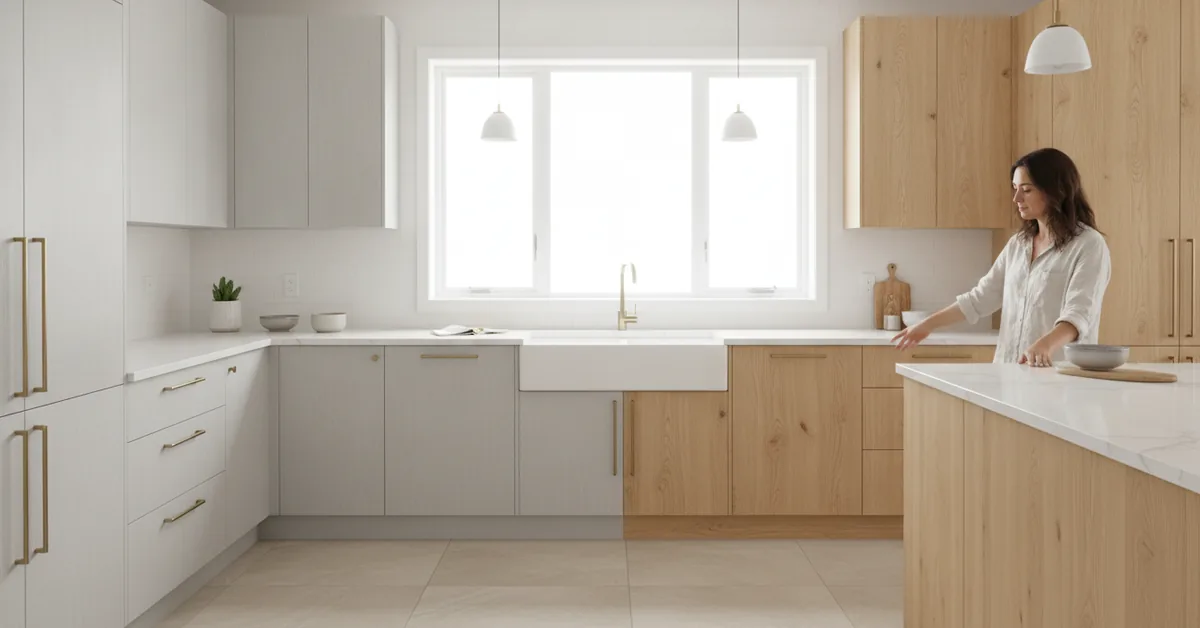
- Absolutely, and this is a hallmark of sophisticated design. I often design kitchens with textured laminate base cabinets for durability in the high-traffic areas, paired with painted solid wood or real wood veneer upper cabinets to add warmth and visual interest. For example, a dark, textured oak TFL on an island provides a robust and stunning anchor, while soft, painted white uppers keep the space feeling light and airy. The key is to create intentional contrast in texture and color, not to try and match them perfectly.