
I can't count the number of times I've walked into a beautiful, newly remodeled kitchen only to spot the first tell-tale sign of trouble. It’s a hairline crack, almost invisible, running right along the stile where it meets the rail of a cabinet face frame. The homeowner often dismisses it as “the wood breathing,” a charming quirk of a natural material. I see it differently. I see a decision made months ago in a workshop, a choice between materials and joinery that has now manifested as a permanent flaw. The truth is, the structural integrity and long-term beauty of your kitchen hinges on the often-overlooked details of its cabinet frame construction, and “solid wood” isn’t always the hero of the story.
The Framework of Quality: Four Pillars of Cabinet Construction
Construction Type Defines Your Kitchen: The choice between a traditional face frame and a modern frameless (Euro-style)
- Construction Type Defines Your Kitchen: The choice between a traditional face frame and a modern frameless (Euro-style) cabinet is the single most important structural decision, impacting everything from aesthetics to hardware options.
- Material Stability Trumps Material Hype: Solid hardwood is excellent, but its tendency to expand and contract can be a liability. High-quality plywood and even MDF/HDF have critical applications where their stability provides a superior, longer-lasting result, especially for painted finishes.
- The Joint is the Weakest Link: The strongest wood is useless if the joints connecting the frame pieces are weak. The method of joinery—from pocket screws to mortise and tenon—is a far better indicator of quality than the wood species itself.
- Finish Adhesion is a Science: The frame material directly dictates how well a finish will adhere and age. A smooth, stable substrate is essential for a flawless painted finish, while an open-grain wood requires a very different approach for a stained finish.
Face Frame vs. Frameless: More Than Just a Look
When clients first come to me, they usually talk about door styles and colors. I immediately steer the conversation to the cabinet box itself. Are we building with a face frame or going frameless? This isn't just an aesthetic choice; it's a foundational one that dictates the entire project's engineering.
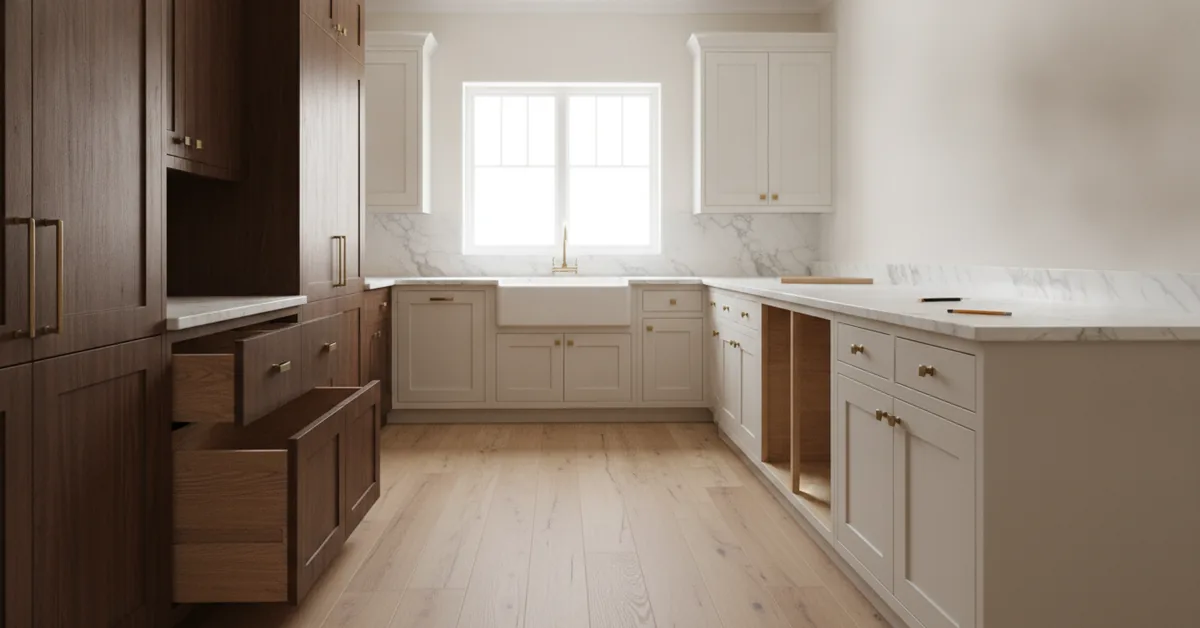
Face Frame cabinets are the traditional American style. Think of a 1.5-inch to 2-inch solid wood frame attached to the front of the cabinet box. This frame adds rigidity and provides a solid mounting surface for doors and hinges. It’s robust, classic, and forgiving with installation, as the frame can hide slight imperfections in wall straightness. However, it slightly reduces the accessible opening of the cabinet.
Frameless cabinets, often called Euro-style, are essentially a box with no front frame. The doors mount directly to the sides of the cabinet box, creating a sleek, full-overlay look with minimal gaps. This style maximizes interior space and accessibility but demands absolute precision in manufacturing and installation. There's no frame to hide imperfections; every box must be perfectly square and perfectly aligned.
The Great Debate: Solid Wood vs. Engineered Materials for Frames
Here’s where I see the most confusion and misinformation. The default assumption is that 100% solid wood is the best. For a stained finish where you want to see the grain of oak, cherry, or walnut, solid wood is indeed the only choice. But for a painted kitchen—which accounts for over 70% of my custom projects today—solid wood can be a long-term problem.
Wood moves. It expands in the humid summer and shrinks in the dry winter. Over years, this movement can cause paint to crack at the joints of the face frame. A few years ago, a client in a coastal area with high humidity insisted on solid poplar frames for her white shaker kitchen. Despite all warnings, she loved the idea of “all wood.” Two years later, I was back to repair fine, spiderweb-like cracks at nearly every single joint. The wood did exactly what wood does, and the paint couldn't keep up.
For painted applications, I now primarily use solid Maple for its tight grain, but for certain large panels or specific situations, high-quality, moisture-resistant HDF (High-Density Fiberboard) can be a superior substrate because it is dimensionally stable. It does not move. This means no joint cracks, ever. It’s about using the right material for the right application, not just defaulting to a romanticized idea of “solid wood.”
Material Suitability Breakdown
| Material | Best Use Case | Primary Advantage | Key Disadvantage |
|---|---|---|---|
| Solid Hardwood (Maple, Cherry, Oak) | Stained finishes, traditional aesthetics | Natural beauty, grain character, repairable | Susceptible to expansion/contraction; can cause paint cracks at joints |
| Furniture-Grade Plywood | Cabinet boxes (carcasses), frameless construction | Excellent strength-to-weight ratio, very stable | Exposed edges must be edge-banded; not ideal for intricate frame profiles |
| HDF/MDF (High/Medium-Density Fiberboard) | Painted cabinet doors (center panels), non-structural components | Perfectly smooth and stable; ideal substrate for paint | Poor screw-holding power if low density; susceptible to water damage if not sealed |
Why Cabinet Joinery is My First Quality Check
You can have the most expensive slab of walnut, but if it’s held together with staples and glue, it’s a low-quality cabinet. The joinery is the true craft. When I inspect another shop’s work, I look at the joints first.
At the lower end, you’ll find simple butt joints with pocket screws. It’s a fast and reasonably strong method, but it can be prone to shifting over time. A step up is the dowel joint, which offers better alignment. The gold standard for high-end face frames, however, is the mortise and tenon joint. This is a classic woodworking technique where a protruding piece (the tenon) on one board fits perfectly into a hole (the mortise) in another. It creates an incredibly strong mechanical and glued connection that resists twisting and pulling. It takes more time and skill, which is why it's a hallmark of true custom cabinetry.
Your Action Plan for Vetting Cabinet Construction
When you're meeting with a designer or cabinet maker, you need to be equipped to ask the right questions. Don't just ask "is it solid wood?" Go deeper to understand the true quality of what you're buying.
- Request a Sample: Ask for a sample corner piece of a cabinet frame. Look at it closely. How are the pieces joined? Is the finish smooth and consistent? Feel the weight and density.
- Question the Materials for a Painted Finish: If you want a painted kitchen, specifically ask, "What material do you use for the stiles and rails, and why?" If they say "solid wood" without explaining how they mitigate joint cracking, be cautious. A craftsman who recommends a stable engineered material for a center panel or even the whole door is showing their experience.
- Inquire About the Box Construction: The frame is just the face. Ask about the cabinet box (the carcass). Is it particleboard or furniture-grade plywood? What is the thickness? For a high-end kitchen, I expect to see 3/4-inch plywood for the box construction.
- Discuss the Finish Process: Ask about the finishing steps. A durable finish isn't just sprayed on. It involves multiple stages of sanding, priming with a high-quality conversion varnish or catalyzed lacquer, more sanding, and then multiple top coats. This process is just as important as the construction itself.
Frequently Asked Questions on Frame Construction
- Is a thicker face frame (e.g., 2 inches vs. 1.5 inches) a sign of better quality?
- Not necessarily. A wider stile and rail is an aesthetic choice, often used to create a more traditional or robust look. The quality is determined by the wood species, the precision of the milling, and the joinery method used, not the width of the frame itself. A perfectly joined 1.5-inch hard maple frame is far superior to a poorly assembled 2-inch pine frame.
- My cabinet maker offers a "beaded" or "inset" face frame. What does this mean and is it worth the extra cost?
- This is a premium construction style. An inset cabinet places the door and drawer fronts inside the face frame, sitting flush with it when closed. A beaded inset adds a decorative routed profile (a bead) around the frame opening. It requires extremely precise craftsmanship because the gaps around the door must be perfectly consistent. It is significantly more labor-intensive, which is why it can increase the cost by 15-25%, but it produces a timeless, high-end furniture look.
- For frameless cabinets, what is the most critical element to ensure long-term durability?
- For frameless, it's all about the box material and the hardware. Since the doors and drawers hang directly on the cabinet sides, the box must be made from a material with excellent screw-holding capacity, like high-grade plywood or industrial-grade particleboard (not the cheap stuff). Secondly, the hardware, especially the hinges and drawer slides, is doing all the work. Investing in top-tier European brands like Blum or Grass with their lifetime guarantees is non-negotiable for a frameless kitchen that will last.