

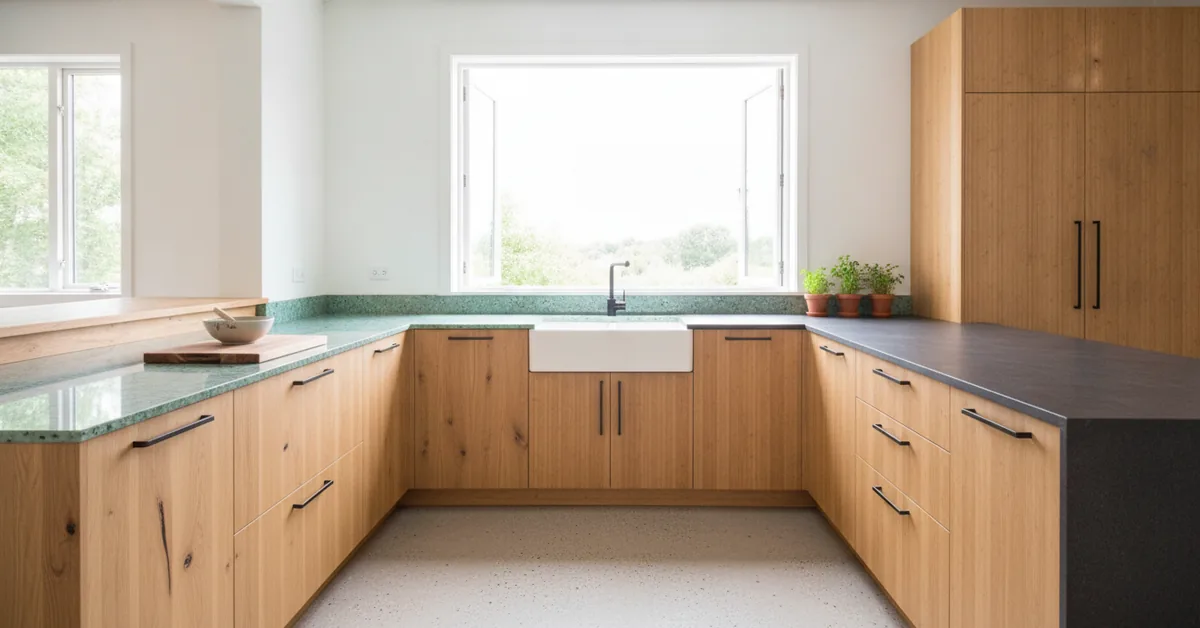
I recently had a client, a wonderful couple building their dream home on the coast, who were absolutely set on bamboo cabinets. They had read everywhere that it was the pinnacle of sustainable design. The conversation that followed is one I have nearly every week. We had to move beyond the marketing headlines and talk about the realities of how materials perform over decades, especially in a humid environment. The truth is, the most 'eco-friendly' kitchen isn't just about a label; it's about building something that won't end up in a landfill in ten years. It's about durability, air quality inside your home, and understanding the entire lifecycle of a material, from forest to finish.
Decoding 'Green' Cabinetry: My Four-Point Assessment Framework
Source & Chain of Custody: It's not enough for a material to be renewable. I always demand to see certifications like
- Source & Chain of Custody: It's not enough for a material to be renewable. I always demand to see certifications like FSC (Forest Stewardship Council) to ensure the wood is harvested responsibly, not just clear-cut from a sensitive ecosystem.
- Adhesives & Binders: The core of a cabinet box is often an engineered wood product. The real health and environmental impact lies in the glues used to bind the wood fibers. I always specify NAF (No Added Formaldehyde) or ULEF (Ultra-Low Emitting Formaldehyde) substrates.
- Durability as a Sustainability Metric: A cabinet made from a fast-growing but soft material that dents, scratches, and fails within a decade is not sustainable. True eco-friendliness is longevity. A well-built hardwood cabinet can last 50 years or more.
- Finishes & Off-Gassing: The material itself can be green, but if it's coated in a high-VOC (Volatile Organic Compound) lacquer, you've compromised the air quality in your home. I prioritize water-based or low-VOC catalyzed conversion varnishes for both health and durability.
The Great Material Debate: Reclaimed Wood vs. Certified Hardwoods
Clients often romanticize reclaimed wood, picturing antique barn boards full of character. I love the aesthetic, but from a craftsman's perspective, it's one of the most challenging materials to work with. It requires extensive de-nailing, milling, and stabilization. The cost isn't in the wood itself, but in the dozens of extra labor hours needed to make it usable for high-precision cabinetry. More importantly, you have to be absolutely certain of its provenance. I once had to reject a batch of beautiful-looking 'reclaimed' lumber because we couldn't verify it hadn't been treated with lead paint or industrial chemicals decades ago. You simply cannot risk bringing those contaminants into a family's kitchen.
On the other hand, new solid wood from an FSC-certified forest is my go-to for high-end, sustainable projects. You get predictability, structural integrity, and a guaranteed chain of custody. For North American projects, I often recommend species like Walnut, White Oak, or Maple from certified sources. They are incredibly durable, and when properly finished, they provide a classic look that won't need to be replaced. The key takeaway is that verifiable, responsible forestry is often a more practical and safer 'green' choice than unvetted reclaimed materials.
Engineered Panels: Where 'Eco-Friendly' Gets Complicated
This is where most of the confusion lies. The cabinet boxes—the unseen structure—are almost always made from an engineered panel. Here's a breakdown of the common options I work with, along with the unvarnished shop-floor reality of their performance.
| Material | Eco-Friendly Claim | My Hands-On Reality Check | Best Use Case |
|---|---|---|---|
| Bamboo Plywood | Rapidly renewable grass, harder than some hardwoods. | The quality varies wildly. Low-grade bamboo uses high-VOC adhesives and can delaminate in humid areas. It's also prone to chipping during fabrication if not handled with specialized tooling. | Modern, flat-panel doors in a dry, stable climate. I'm hesitant to use it for sink bases. |
| NAF Plywood | Made with soy-based or other formaldehyde-free adhesives. Often FSC certified. | This is my workhorse for high-quality, healthy cabinet boxes. The multi-ply construction offers superior screw-holding power and structural stability compared to particleboard. It is the gold standard for durable, eco-conscious construction. | The entire cabinet carcase, especially for island bases and tall pantry units that bear significant weight. |
| ULEF Particleboard | Uses recycled wood fiber and ultra-low emitting resins. | It's dimensionally stable and flat, which is great for laminate doors. However, it has poor screw-holding strength over time and swells irreversibly with even minor water exposure. I've seen far too many particleboard sink bases crumble after a small leak. | Budget-conscious projects for non-critical areas like a utility room or closet, never near a water source. |
| Wheatboard / Strawboard | Made from agricultural waste fibers (wheat or sorghum stalks). | An excellent concept, but the material is heavy and can be brittle. It's also more susceptible to moisture damage than wood-based panels. The technology is improving, but it's not yet a mainstream replacement for wood plywood in a high-use kitchen. | Decorative panels or low-stress applications where its unique texture can be a feature. |
The Unseen Factor: Low-VOC Finishes and Hardware
A perfectly sourced, formaldehyde-free cabinet can be ruined by the finish. For years, the industry standard was solvent-based lacquers that were durable but released a huge amount of VOCs during application and curing. Today, the technology for water-based finishes has come a long way. I now use a two-component (2K) water-based polyurethane for a majority of my projects. It provides about 90% of the durability of a catalyzed varnish with a fraction of the harmful off-gassing. This is a non-negotiable for clients with chemical sensitivities or young children.
Hardware is another piece of the puzzle. Look for manufacturers with transparent environmental policies. Many high-quality European brands like Blum or Grass produce their hinges and drawer slides in facilities that use renewable energy and have robust recycling programs. Choosing durable hardware that will last the life of the cabinets prevents the waste of having to replace it every few years.
Your Action Plan for a Truly Sustainable Kitchen
When you're ready to start planning, it's easy to get overwhelmed. Here is the exact process I walk my clients through to cut through the noise and make informed decisions.
- Ask for the Paperwork: Don't just take a cabinetmaker's word for it. Ask to see the spec sheets for the panel products they use. Look for the terms "NAF," "ULEF," and "FSC Certified." If they can't provide them, that's a red flag.
- Prioritize the Box Construction: Focus your budget on the cabinet carcase first. A beautiful door on a cheap particleboard box is a recipe for failure. Insist on a quality NAF plywood box, as it's the foundation of your entire kitchen.
- Inquire About the Finish: Ask your designer or cabinet shop specifically what type of finish they use. Ask about VOC content and whether they offer low-VOC or water-based alternatives. Understand the durability trade-offs, if any.
- Think Long-Term: Choose a timeless design and a durable material that you will love for decades. The most sustainable choice is avoiding the need to remodel again in the near future. Resist fast-moving trends that will look dated in five years.
Frequently Asked Questions from My Design Consultations
- Is solid wood always better than plywood for cabinet doors?
- Not necessarily. For painted finishes, especially in climates with high humidity swings, I often recommend doors made from a NAF MDF panel. Solid wood expands and contracts, which can cause hairline cracks in the paint at the joints. A high-quality, stable MDF panel provides a flawless, durable painted surface that won't crack. For stained finishes where you want to see the grain, solid wood is, of course, the superior choice.
- Are bamboo floors and bamboo cabinets the same in terms of durability?
- Absolutely not. This is a critical distinction. Most high-quality bamboo flooring is 'strand-woven,' a process where bamboo fibers are compressed under extreme pressure with resin, making it incredibly dense and durable. Bamboo plywood used for cabinets is typically 'laminated,' meaning strips are simply glued together. This laminated version is significantly softer and more prone to denting and water damage than its flooring counterpart. They are two completely different products sharing the same plant source.
- How can I verify if 'reclaimed wood' is safe and truly reclaimed?
- This requires a reputable supplier who can provide a chain of custody. Ask where the wood came from—a specific barn, a factory, a dismantled warehouse. A trustworthy dealer will be able to tell you the story of the material. They should also be able to confirm that it has been scanned for metal, properly kiln-dried to exterminate any pests, and tested for hazardous substances like lead if it was previously painted. If the price seems too good to be true, it's likely unvetted and potentially unsafe.