

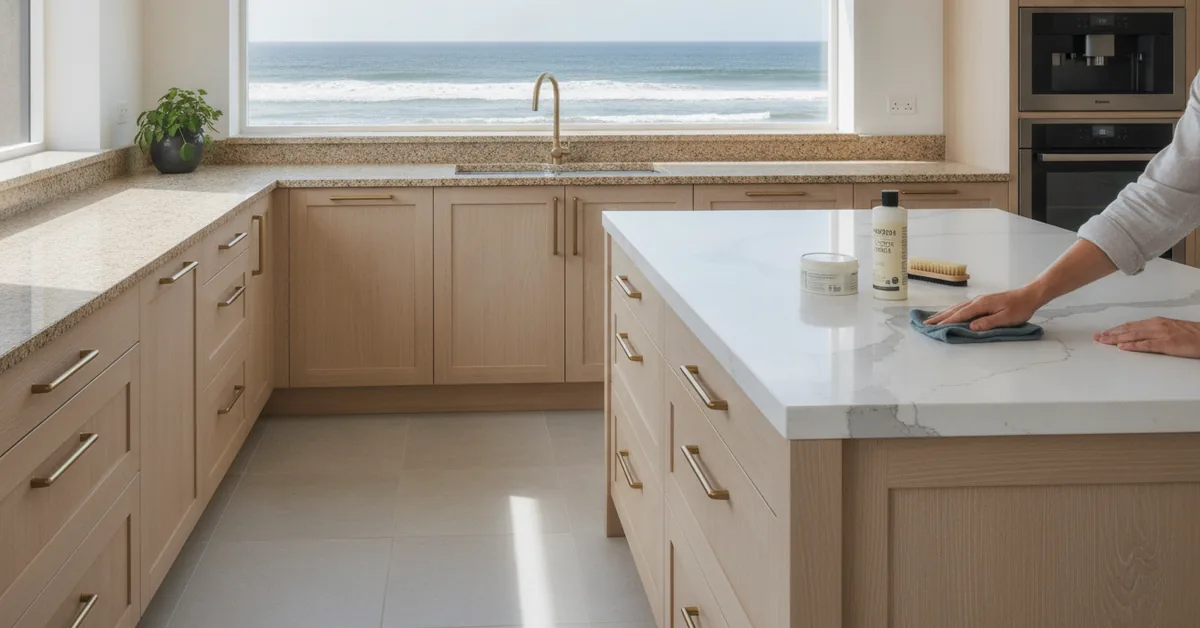
I still remember the call. A client from a beautiful beachfront home, just two years after we finished a stunning custom kitchen, was distraught. The soft-close hinges on her shaker doors were grinding, and a strange, subtle pitting was appearing on the handles. The culprit wasn't a defect; it was the very air she loved. The salty, humid coastal air had begun its relentless work, bypassing a perfectly good finish to attack the metal and creep into the unseen edges of the wood. This is the reality of a coastal kitchen: the battle isn't just against splashes and spills, but against the atmosphere itself.
Your Four-Point Defense Against Salt Air Corrosion
Material Selection is Paramount: The foundation of longevity isn't the finish, but the core material's stability in
- Material Selection is Paramount: The foundation of longevity isn't the finish, but the core material's stability in high humidity. Engineered materials often outperform solid wood in this specific environment.
- The Finish is a Shield, Not a Seal: A high-quality, factory-applied finish is crucial, but it's the first line of defense, not an impenetrable barrier. Its integrity must be maintained.
- Hardware is the Canary in the Coal Mine: Corrosion will almost always appear on hinges, pulls, and slides first. Specifying the correct grade of stainless steel or a marine-grade finish is non-negotiable.
- Consistent, Gentle Maintenance is Key: A proactive cleaning and inspection routine is the only way to combat the slow, persistent attack of salt aerosol deposits.
Why Solid Wood Isn't Always the King in a Coastal Kitchen
There's a romance to solid wood, an assumption that it's the pinnacle of quality. In many applications, it is. But in a high-humidity, salt-laden environment, it has an Achilles' heel: movement. Wood breathes; it expands and contracts with changes in moisture. On the coast, this movement is constant and extreme. This constant shifting can stress joints and, more critically, create microscopic cracks in the finish, giving salt and moisture a direct path to the raw wood. This is why, in my shop, we often guide coastal clients toward specific materials.
I’ve seen gorgeous solid maple doors develop hairline fractures at the joints within three years, not from poor craftsmanship, but from the wood's natural reaction to the environment. The finish just can't stretch and shrink with it forever. This is where high-grade engineered materials show their strength. The stability of a premium MDF or marine-grade plywood core means the finish applied over it remains intact and unstressed for much longer.
Comparing Core Materials for a Saltwater Environment
Choosing the right substrate is the most important decision you'll make for your coastal cabinets. It dictates how well your finish holds up and how resistant the entire structure is to warping and delamination. Here’s a breakdown I often walk my clients through:
| Material | Pros | Cons | Best For |
|---|---|---|---|
| Solid Wood | Authentic look and feel, repairable. | Prone to significant expansion/contraction, can crack the finish at joints, higher cost. | Homes with excellent, stable climate control; homeowners committed to diligent maintenance. |
| High-Density Fiberboard (HDF/MDF) | Extremely stable, no grain to telegraph through paint, provides a flawless surface for opaque finishes. | Not suitable for staining, heavy, susceptible to catastrophic damage if the finish is breached and it gets saturated. | Painted cabinet doors, especially shaker or flat panel styles, in any coastal setting. |
| Marine-Grade Plywood | Incredibly stable, highly water-resistant due to waterproof glues, holds screws well. | More expensive than standard plywood, edges can be difficult to finish perfectly. | Cabinet boxes (carcasses) and high-end custom slab doors. The gold standard for cabinet construction. |
| Polymer / High-Pressure Laminate (HPL) | Completely waterproof and inert, easy to clean, highly durable finish. | Can have a less premium feel, limited in design styles (mostly slab doors), cannot be refinished. | Outdoor kitchens, laundry rooms, or ultra-modern indoor kitchens where durability is the absolute priority. |
The Unseen Enemy: Your Cabinet Hardware
The first place I look for trouble in a coastal kitchen is the hardware. Standard cabinet hinges and drawer slides are typically made from zinc-plated steel. In a dry, inland home, they last for decades. Near the ocean, I've seen them show rust spots in under 18 months. The salt aerosol settles on these metal parts, and overnight condensation provides the moisture needed to start the corrosive process.
You must insist on stainless steel hardware. But even then, not all stainless is created equal. For coastal applications, Type 304 stainless steel is the minimum, but Type 316, which includes molybdenum, offers far superior corrosion resistance and is considered marine-grade. It's a significant cost increase—sometimes 50-75% more for the hardware package—but it's the difference between a kitchen that functions smoothly for decades and one that needs a costly hardware replacement in a few years.
Your Step-by-Step Coastal Cabinet Care Routine
Protecting your investment is an ongoing process, not a one-time event. The goal is to regularly remove the invisible salt deposits before they can cause harm. Here is the exact process I give to my clients upon project completion.
- Weekly Dusting and Wiping: Use a dry, soft microfiber cloth to dust all cabinet surfaces. This removes loose salt and dust particles. Follow up with a separate microfiber cloth that is very lightly dampened with fresh, clean water. Wring it out until it's almost dry.
- Wipe in the Direction of the Grain: For wood or wood-veneer cabinets, always wipe with the grain. For painted surfaces, a consistent direction is still best. This prevents streaking and ensures you cover the entire surface.
- Immediately Dry the Surface: Never leave water to air dry on your cabinets. Use a third, completely dry microfiber cloth to buff the surfaces dry immediately after damp-wiping. This is the most critical step to prevent moisture intrusion.
- Monthly Hinge and Hardware Check: Once a month, open each cabinet door and wipe down the hinges with a dry cloth. Look for any signs of pitting or discoloration on pulls and knobs. This early detection is key.
- Quarterly Deep Clean: Every three to four months, use a mild, pH-neutral cleaner. Mix a few drops of a gentle soap (like a diluted, clear dish soap) in a gallon of warm water. Use the same damp-wipe-dry method as above. Avoid harsh chemicals, vinegar, or abrasive cleaners at all costs.
- Annual Inspection: Once a year, take a close look at all the seams and joints, especially around the sink and dishwasher. Check the finish for any cracks, chips, or wear. A small touch-up now can prevent a major repair later.
Frequently Asked Questions from My Coastal Clients
- Is a marine varnish a good idea for my kitchen cabinets?
- While it sounds logical, I strongly advise against using marine or spar varnish for interior kitchen cabinets. These finishes are designed to be flexible for boats that expand and contract dramatically in direct sun and water. They are often softer, can yellow over time, and are not formulated to resist the oils, acids, and cleaning agents found in a kitchen. A high-quality, catalyzed conversion varnish or a two-part polyurethane, applied in a controlled factory setting, is a much harder and more chemically resistant finish for cabinetry.
- My cabinet installer suggested we just get stainless steel-look hardware instead of true stainless steel. Is that okay?
- Absolutely not. This is a corner I see cut far too often to save a few hundred dollars. "Stainless-look" or "brushed nickel" finishes are typically a plating over a base metal like zinc or steel. Once that thin plating is scratched or compromised by the salt air, the metal underneath will rust quickly and the finish will start to bubble and peel. You must specify solid, Type 304 or 316 stainless steel for all metal components, including screws.
- What about ventilation? How much does it really matter for the cabinets?
- Ventilation is a game-changer. It's as important as the materials themselves. A high-quality range hood that vents to the outside is crucial, not just for cooking fumes, but for removing moisture from the air. I also encourage clients to run their air conditioning or a dehumidifier regularly, even on milder days, to keep the relative humidity inside the home below 55%. Stable, dry air puts far less stress on the wood and finishes and slows the corrosive effects of any salt that does get inside.